

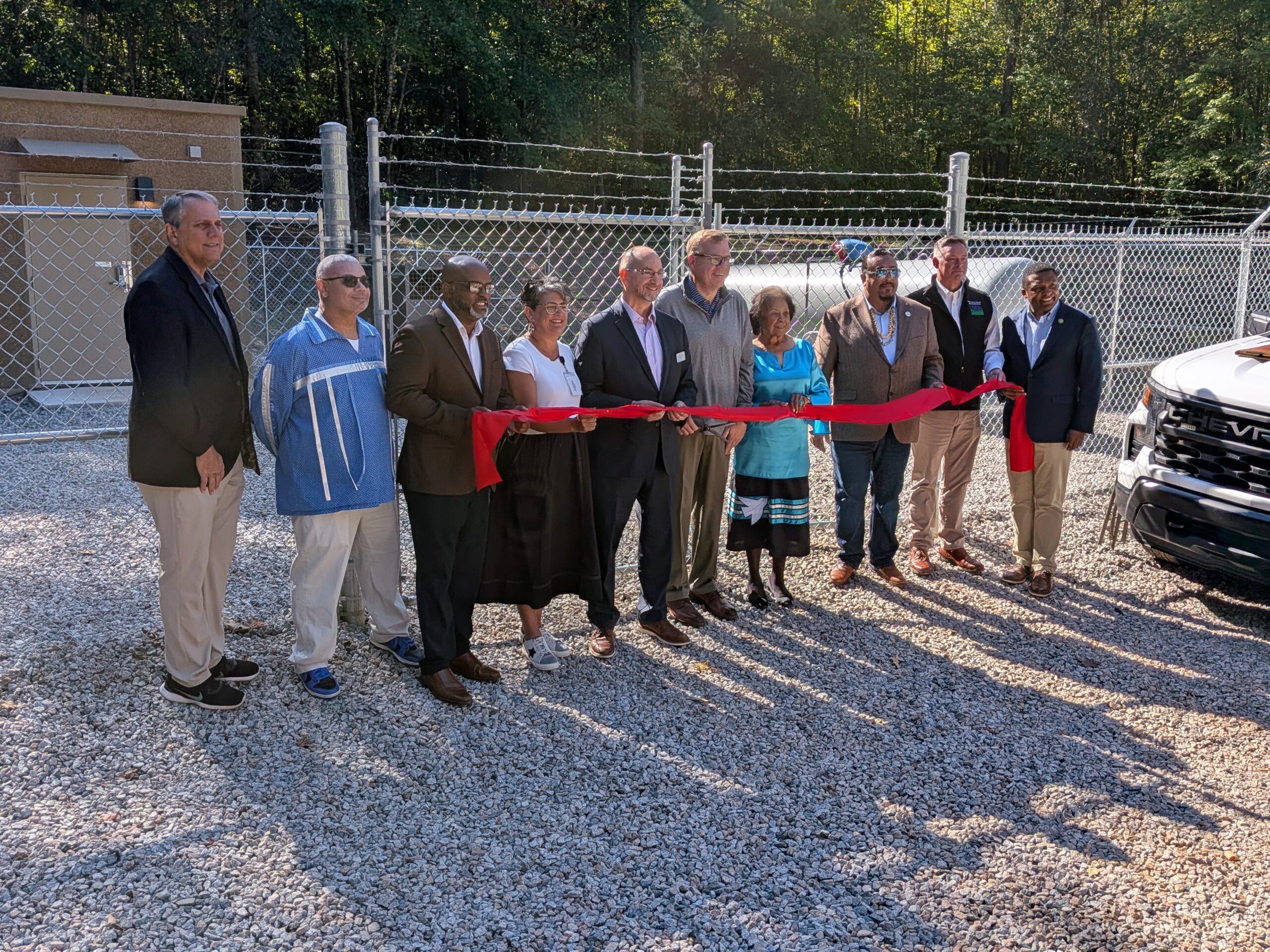
October 6, 2026 – AccessOn Internet joined federal, state, tribal and local leaders Tuesday to celebrate the ribbon cutting of its Essex Central Fiber Hub, marking a major milestone in a $17.5 million USDA Rural Development ReConnect project bringing high-speed fiber Internet to more than 2,500 addresses across rural portions of southeastern Warren and southwestern Halifax counties.
The fully underground fiber network is designed to reach communities where geography, population density and the economics of traditional broadband deployment have historically made reliable high-speed Internet difficult to obtain.
The ceremony began with a blessing of the grounds by Dr. Marvin Richardson, offered in the Haliwa-Saponi native language, followed by a blessing for those gathered.
U.S. Congressman Don Davis, representing North Carolina’s 1st Congressional District, spoke about the federal investment behind the project and the impact broadband access can have for families, businesses, farms and communities across eastern North Carolina.
“Thank you for the subtle reminder of the inspiration that gets us here. Thank you for the subtle reminder of what it means to put people first, our families first, here in eastern North Carolina—to truly, especially for us, put the American dream back in reach,” Davis said. “This program, this project coming from ReConnect, this $17 million, it will help families. We’re talking about homes, businesses, farmers—that’s where agriculture’s heading these days. There’s so many real-world applications.”
Robert Hosford, Director of State Operations for USDA Rural Development, emphasized that reaching communities that might otherwise remain on the difficult “last mile” of connectivity is central to USDA Rural Development’s mission. “This is a $17 million grant, and I say grant, but this is our mission—to deliver for communities that maybe otherwise couldn’t get that last mile,” Hosford said. “Everybody knows the last mile; that’s the hardest mile, and we try to get there.”
Hosford also placed the investment within USDA Rural Development’s long history of helping bring essential infrastructure to rural America. “Back when your grandparents didn’t have telephone or electricity, Rural Development was putting up power poles, and we’ve changed to broadband,” Hosford said. “We’ve changed with the times, and it’s going to change again, and we’re going to be here to support your community.”
Speakers throughout the celebration emphasized that the project’s significance extends beyond the physical fiber network to the opportunities connectivity creates for education, healthcare, agriculture, small businesses and future generations.
“As we cut this ribbon today, we are celebrating more than fiber equipment and infrastructure. We are celebrating the possibilities that will come with being connected,” said Chief Dr. Ogletree Richardson of the Haliwa-Saponi Indian Tribe. “Most importantly, we are investing in future generations.”
North Carolina Rep. Rodney D. Pierce highlighted the importance of connectivity for education and telehealth, while North Carolina Department of Administration Secretary Gabriel Esparza noted that national conversations about emerging technologies often assume basic Internet infrastructure is already available everywhere. “We are still in the process, celebrating this today, of just ensuring basic digital access for everyone,” Esparza said.
The milestone also reflects years of collaboration among federal, state, tribal and local partners. AccessOn Networks’ Strategic Advisor – Business Development, Erik Dixon, recalled that one of the early inspirations for the project came during a Halifax County Commissioners meeting when a mother described the difficulty her children faced completing schoolwork because they did not have Internet access at home. That need helped shape a project intentionally built around local service, including establishing a local office and hiring within the communities AccessOn serves.
Halifax County Board of Commissioners Vice Chair Chenoa Richardson-Davis, herself a resident of the project area, said she has encouraged residents to be patient as the network was built. “I’ve been telling everyone, ‘Just wait, just be patient, it’s coming, and it’s going to be awesome when it gets here,’” Richardson-Davis said. “We’re just so excited to have you all here and look forward to the partnership that we will continue to build upon.”
Greg Richardson, Executive Director of the North Carolina Commission of Indian Affairs, also praised the inclusion of the Haliwa-Saponi community throughout the project, describing the collaborative approach as a model that could be applied in other communities.
“Bringing fiber to rural communities takes far more than fiber equipment and construction crews,” said Jan Harris, AccessOn Internet Site Manager. “It takes investment, it takes partnerships, and it takes people who are willing to work together, sometimes for years, because they believe that where someone lives should not determine whether they have access to the connectivity so many of us depend on every day.”
Areas in southern Warren and southwestern Halifax counties can expect to see active fiber construction through 2027. AccessOn remains committed to keeping communities informed as service becomes available in new areas as construction is completed.
As AccessOn expands its network, the company remains committed to providing straightforward, affordable service options for local residents. Customers enjoy transparent pricing, no installation fees, and access to fiber Internet plans designed to meet the needs of households of all sizes.
Residents interested in learning more about service availability can visit AccessOn Internet’s website, call the local office at (252) 210-4884, or stop by at 107 E Franklin St, Warrenton, Monday-Friday, 9am to 5pm, except major holidays.